Probabilistic Quantitative Trading System
View on GitHub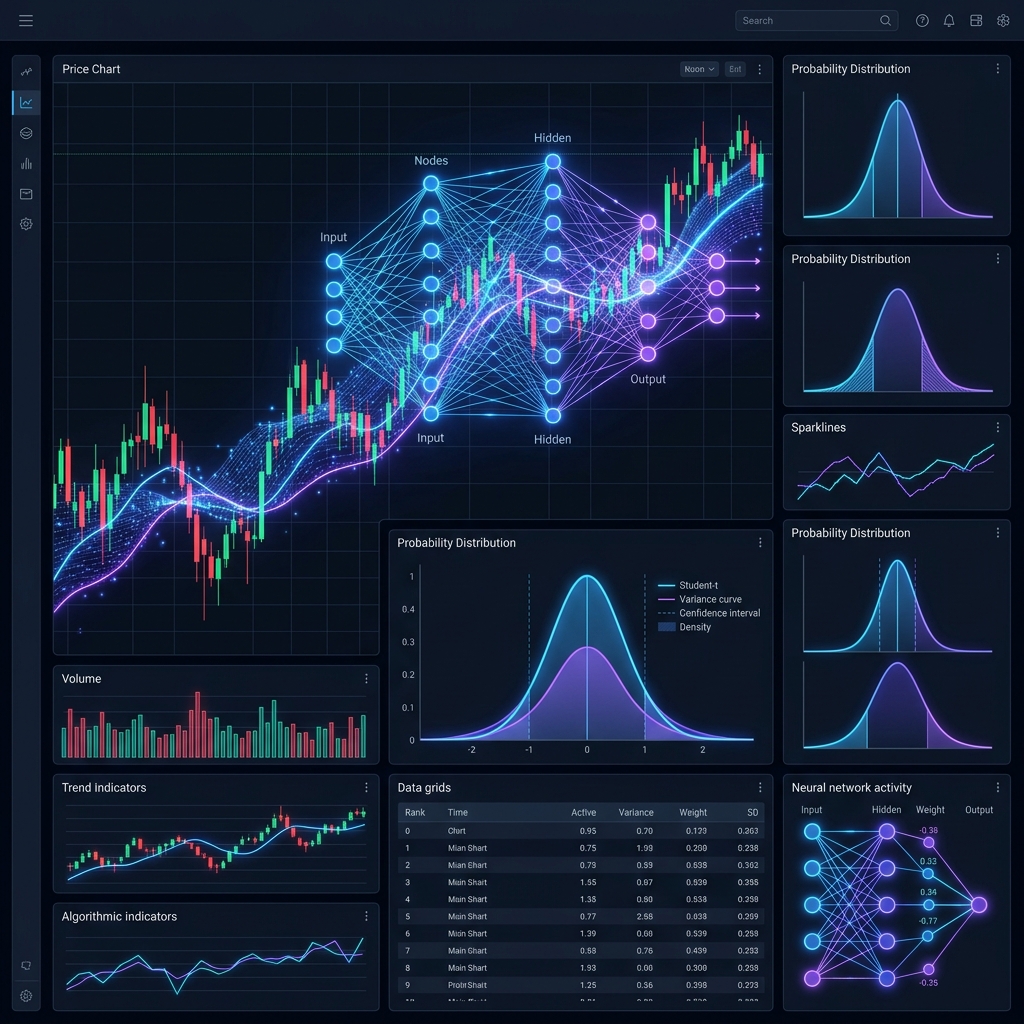
The Challenge
Financial markets are inherently noisy, non-linear, and exhibit heavy-tailed return distributions that defy traditional Gaussian assumptions. Building a trading system that can reliably capture alpha while managing risk requires sophisticated probabilistic modeling and rigorous validation to avoid overfitting and look-ahead bias.
My Solution
I architected a full-stack quantitative trading system combining cutting-edge deep learning with production-grade backtesting, designed to model the true uncertainty of financial returns rather than just point predictions.
Key Features & Technical Implementation:
-
Probabilistic Deep Learning Architecture: Designed a novel model combining Transformer attention mechanisms with Mixture of Experts (MoE) layers to capture non-linear market dynamics. The model outputs Student-t distributions rather than point estimates, properly modeling the heavy-tailed nature of financial returns.
-
Production-Grade Backtesting Engine: Engineered a comprehensive backtesting framework with realistic transaction cost modeling, volatility-based position scaling, and walk-forward validation to prevent look-ahead bias — a critical flaw in many academic trading systems.
-
Superior Risk-Adjusted Performance: Achieved a Sharpe Ratio of 1.23 and 25.04% annualized return (CAGR) in out-of-sample testing, significantly outperforming the SPY benchmark (Sharpe: 0.71, CAGR: 15.52%) through optimized cross-sectional stock ranking.
-
GPU-Accelerated Training: Leveraged PyTorch with CUDA acceleration for efficient training on large financial datasets, implementing custom loss functions for probabilistic likelihood optimization.
This project demonstrates mastery of advanced deep learning, financial engineering, and rigorous scientific methodology applied to real-world quantitative finance.